
Table of Contents
- What is Whisky Distillation?
- The Basics and Purpose of Distillation
- How Distillation Defines Flavor Profiles
- The Big Picture of Whisky Production
- Selecting Raw Materials and Preparation
- The Flow from Fermentation to Distillation
- A Detailed Look at the Distillation Process
- How Pot Stills (Batch Distillation) Work
- How Column Stills (Coffey Stills) Work
- Distillation Frequency and Its Impact on Flavor
- Still Structure and Design Variations
- How Still Shape Influences Flavor
- The Role and Benefits of Copper Stills
- Temperature Management and Cut Points
- The Difference Between Heads, Hearts, and Tails
- Cut Points for Individual Distilleries
- Characteristics of Japanese Craft Whisky Distillation
- Unique Japanese Techniques and Styles
- Innovations in Small-Scale Distilleries
- How Distillation Affects Whisky Maturation
- The Relationship Between Alcohol Quality and Aging
- The Interaction Between Distillation and Cask Selection
- Essential Knowledge for Opening a Distillery
- Key Points for Equipment, Licensing, and Location
- Costs and Legal Aspects for Beginners
- Summary
What is Whisky Distillation?
The Basics and Purpose of Distillation
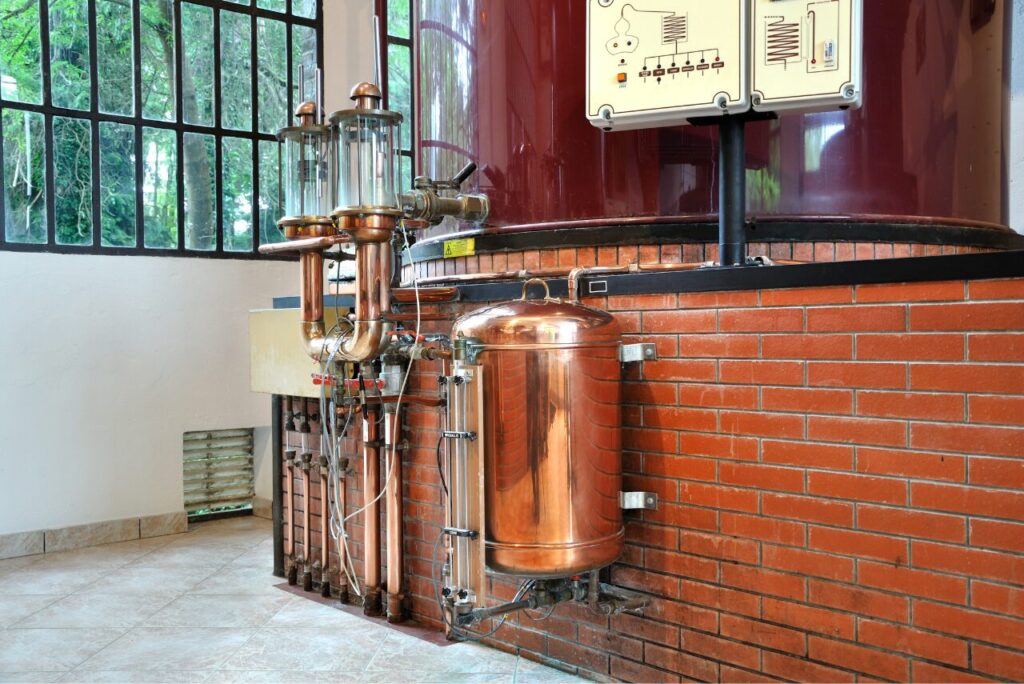
In the context of whisky, “distillation” is the process of extracting alcohol and flavor components from a liquid created through fermentation.
The primary goal of this process is to increase the alcohol concentration while condensing the essential aromas and tastes that form the core of the whisky.
By heating the liquid, components with different boiling points are separated, allowing rich flavor profiles to be drawn out effectively.
How Distillation Defines Flavor Profiles
There are various methods of distillation, each of which significantly impacts the aroma and mouthfeel of the whisky.
For example, differences in the shape and material of the still, the temperature and duration of distillation, and the number of distillation cycles affect peatiness, fruitiness, smokiness, and body.
These variations shape the individuality of each distillery and brand, creating flavors that are truly one of a kind.
The Big Picture of Whisky Production
Selecting Raw Materials and Preparation
The first step in determining the taste of whisky lies in the selection of raw materials.
Malt whisky uses malted barley, while grain whisky utilizes corn, wheat, or rye.
Using high-quality ingredients results in a significantly richer flavor profile in the subsequent stages of production.
During the preparation stage, hot water is added to crushed malt to extract sugars and create a liquid called “wort,” which is then filtered before moving to fermentation.
The Flow from Fermentation to Distillation
When yeast is added to the sugary wort, it ferments over several days to produce a liquid called “wash,” which contains alcohol.
At this stage, the alcohol concentration is roughly 7% to 10%.
The role of distillation is to heat this wash and separate the alcohol and flavor components based on their boiling points to obtain a high-concentration distillate.
The complex components born during fermentation are further refined and polished during this stage.
A Detailed Look at the Distillation Process
How Pot Stills (Batch Distillation) Work
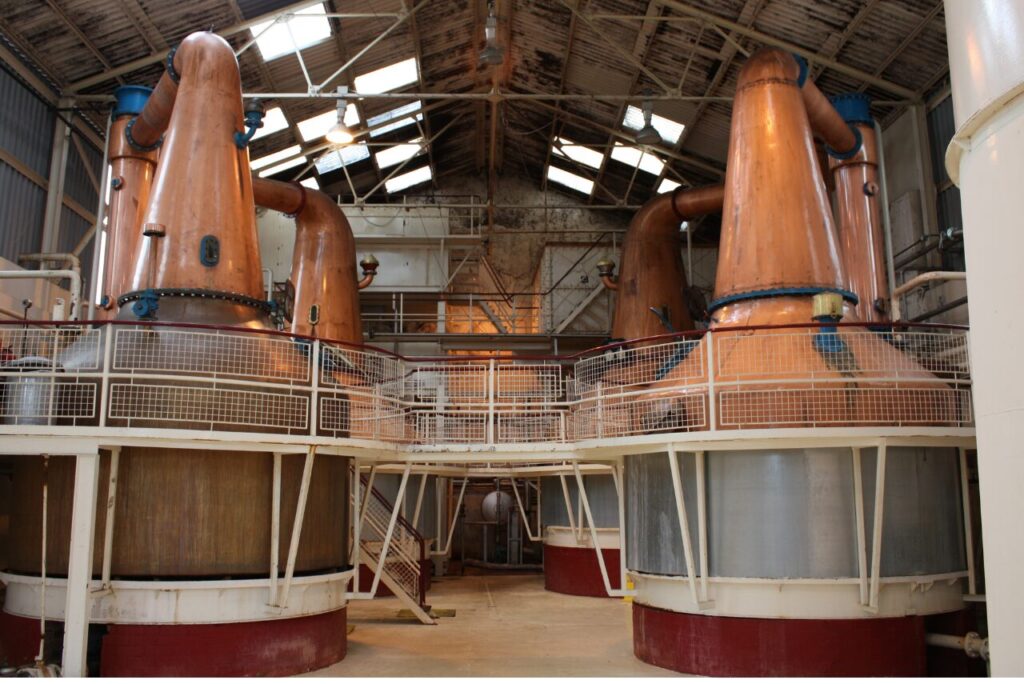
Pot stills use large, copper, pot-shaped vessels to perform distillation in individual batches.
This method is primarily used in traditional production, such as for Scotch whisky.
By distilling the liquid twice or more, impurities are removed, resulting in a fragrant and smooth flavor profile.
Copper stills facilitate chemical reactions that remove unpleasant sulfurous odors, allowing for a higher quality and cleaner spirit.
How Column Stills (Coffey Stills) Work
Continuous distillation was developed in the 19th century by the Irish engineer Aeneas Coffey and allows for the continuous production of high-concentration alcohol by passing vapor through multiple columns.
This method enables mass production and yields a clear, light-bodied spirit.
It is commonly used for grain whisky and American whiskey.
Many modern distilleries adopt this method for its high efficiency.
Distillation Frequency and Its Impact on Flavor
The number of times a spirit is distilled also plays a crucial role in determining its flavor.
Two distillations are standard for Scotch, while three are common for Irish whiskey.
In contrast, some American whiskies are finished after a single distillation.
Increasing the number of distillations removes more impurities, resulting in a smoother and lighter mouthfeel, though it may also thin out the character of the raw materials.
The philosophy of each distillery is clearly reflected in this choice.
Still Structure and Design Variations
How Still Shape Influences Flavor
The shape of a whisky still is one of the factors that most heavily influences the final flavor profile.
Minute differences in the height of the still, the slope of the neck, the size of the body, and the angle of the lyne arm affect vapor flow and condensation speed.
These nuances dictate the resulting aroma and texture of the whisky.
Tall, slender stills tend to produce light and fruity spirits, whereas short, squat stills often yield spirits with a heavy, oily texture.
The Role and Benefits of Copper Stills
Copper is used for stills for reasons beyond mere tradition.
Copper has high thermal conductivity, which allows for uniform heating.
More importantly, it possesses chemical properties that allow it to react with and remove sulfurous odors and off-flavors.
This ensures that the resulting distillate is clean and refined.
Furthermore, it is believed that the oxidation of copper during the process promotes the formation of aromatic compounds, making the still much more than just a piece of hardware.
Temperature Management and Cut Points
The Difference Between Heads, Hearts, and Tails
In whisky distillation, the heating temperature, timing, and the “cut points”—deciding which parts of the distillate to collect—are extremely important.
The initial liquid, known as the “heads” (or foreshots), contains highly volatile and pungent components.
The central portion, known as the “heart,” possesses the most desirable flavors and aromas for whisky.
The final portion, the “tails” (or feints), contains heavy oils and impurities.
Cut Points for Individual Distilleries
The “heads,” “hearts,” and “tails” all have different properties, and deciding which parts to use for the final product depends on the distillery’s philosophy.
Because the heads have a high alcohol content and contain volatile compounds like acetone, most distilleries discard or redistill them.
The heart is the most balanced part, possessing rich aromas, sweetness, and body; this is the portion that becomes the final product.
The tails contain heavy, oily components that can add depth but also introduce harsh off-flavors.
Even when using identical stills, cut points vary significantly between distilleries.
Some may take a wide “heart” cut to pursue a lighter taste, while others may narrow the cut to obtain a more concentrated and heavy spirit.
These standards are determined by the target flavor, brand policy, and years of trial and error.
Characteristics of Japanese Craft Whisky Distillation

Unique Japanese Techniques and Styles
The reason Japanese craft whisky is highly acclaimed worldwide lies in its technical precision, uniqueness, and regional innovations.
The greatest appeal of Japanese craft distilling is the ability to design delicate recipes and pursue individual character through small-batch production.
Furthermore, traditional Japanese sake-brewing knowledge is often applied to whisky making.
Fermentation management techniques and the influence of Koji culture developed for sake are sometimes reflected in the fermentation and maturation stages.
This represents a fusion of Japan’s unique fermentation culture with craft whisky.
Innovations in Small-Scale Distilleries
Craft whisky distilleries across Japan leverage their small scale to achieve flexibility and creativity impossible for large producers.
For example, by keeping batch sizes small, they can respond delicately to ingredient ratios, yeast selection, and fermentation temperature control.
This allow them to react to seasonal and weather changes to draw out the optimal flavor.
Rather than relying on off-the-shelf products, an increasing number of craft distilleries collaborate with local metalworkers to design original stills.
By focusing on custom shapes and materials, they can pursue a spirit quality that better reflects their region and brand concept.
Some distilleries even use different distillation programs or frequencies for each specific product line.
How Distillation Affects Whisky Maturation
While maturation is the process where spirit changes slowly over years inside a wooden cask, the distillation process is the starting point that defines the final flavor.
It is crucial to understand how the quality of alcohol obtained through distillation interacts with the aging process.
The Relationship Between Alcohol Quality and Aging
The spirit produced by distillation is not just a collection of ethanol.
It contains various components such as fusel oils, esters, and aldehydes that serve as the source of flavor.
The balance of these components dictates how the spirit will evolve during maturation.
Lighter spirits tend to absorb cask-derived aromas like vanilla and caramel relatively quickly.
In contrast, heavier spirits have the structural backbone to withstand long-term maturation, developing complex notes of spice, leather, and dried fruit over time.
The Interaction Between Distillation and Cask Selection
The compatibility between the distilled spirit and the cask is vital in determining the whisky’s final personality.
Even with the same American White Oak, the flavors absorbed will vary greatly depending on the toast level and previous use (e.g., bourbon, wine, or sherry).
If the spirit has a high content of oils and acids from distillation, the reaction with the oak components may intensify, resulting in a richer flavor.
Conversely, a cleaner spirit can highlight the transparency and delicate notes of a specific cask.
Distillation and maturation are not separate steps but two essential pillars that complement each other to form the ideal whisky.
Essential Knowledge for Opening a Distillery
If you aim to open a whisky distillery, you need more than just passion; you need concrete and realistic preparation.
In Japan, you must organize your equipment and licenses while complying with various laws, such as the Liquor Tax Act.
Key Points for Equipment, Licensing, and Location
First, a “Spirits Manufacturing License” is required to produce whisky.
Obtaining this involves a detailed examination of annual production volume and financial requirements, often taking more than six months from application to approval.
You will also need a clear business plan, equipment diagrams, and a fund-raising plan.
In terms of equipment, you need fermentation tanks, a still, cooling systems, maturation casks, bottling equipment, and laboratory functions for quality control.
Regarding location, an area with high water quality and temperature fluctuations is considered desirable.
Building a relationship with the local community is also indispensable for sustainable management.
Costs and Legal Aspects for Beginners
The initial investment typically requires a capital of tens of millions to hundreds of millions of yen.
Costs for purchasing stills and casks, renovating or building facilities, and trial brewing are significant.
Additionally, since whisky must be matured for several years, it takes time for the business to become profitable.
Legally, there are various regulations beyond the manufacturing license, including fire safety laws for flammable alcohol, food sanitation laws, and industrial waste disposal laws.
Cooperating with experts and building a good relationship with administrative authorities is essential for managing these permits.
Summary
In this article, we have explored everything from the basics of distillation to Japan’s unique craft culture and the knowledge required to open a distillery.
Whisky distillation is not just a manufacturing step; it is an intellectual and artistic process of drawing out the essence of materials.
Every drop encapsulates the distiller’s philosophy, equipment innovation, regional climate, and the future of its maturation.
The evolution of craft whisky in Japan has only just begun.
Whether you wish to open a distillery or simply want to understand the depth of whisky, this is a treasury of knowledge that grows richer the more you learn.
We invite you to begin your own journey into the world of whisky distillation from here.
[ForCompanies Considering Craft Whisky Production]
A Must-Read for Those Planning to Launch a Craft Whisky Distillery. Did you know that by integrating a microbrewery model, it is possible to produce craft whisky even on a small scale?
Furthermore, we offer a strategy to generate revenue even during the long maturation period.Why not consider launching your craft whisky business with Augst Beer?
We have a proven track record of supporting successful distillery launches across Japan.
[Request Information]